
Identify Who Owns a Montgomery County Property
The surest path runs from geography to the assessment roll, then to the recorded instrument. Montgomery County's parcel landing page is the official starting point. When that application will not load, ORKA serves as a fallback. The county tax system and county offices also help. Keep the parcel number handy as you move between them.
- Start at the official Parcel Search page or locate the land in Kansas GIS/ORKA.
- Retain the tax identifier, site address, and legal description, then inspect the assessment or tax account's displayed owner.
- Ask the Register of Deeds for the latest conveyance affecting that legal description and compare its grantee.
- If the grantee is an entity, verify its exact name through the Kansas Business Entity Search. Never assume a mailing address identifies an occupant.
When the Montgomery Parcel Portal Will Not Open
The county calls its parcel-search data reliable and current. Even so, the direct application sometimes fails to open, returning a TLS or 502 error. Its required fields and parcel-number format are not documented. Do not borrow assumptions from another Kansas county. ORKA covers parcel geography, while the Treasurer's search works by owner, address, statement number, or tax ID, and the Appraiser at 620-330-1050 can supply the assessment record. Narrow requests for non-exempt records can go through the county KORA form.
Note: Ask whether a displayed name is the assessment owner, mailing owner, or another database label.
Use Montgomery Tax Fields as Identity Clues
An ACT account page can list account number, owner, mailing address, property site address, legal description, balances, payments, valuation components, exemptions, and linked yearly details. That field layout helps match an address to a parcel identity. It cannot prove title. The official ACT detail route displays the arrangement.
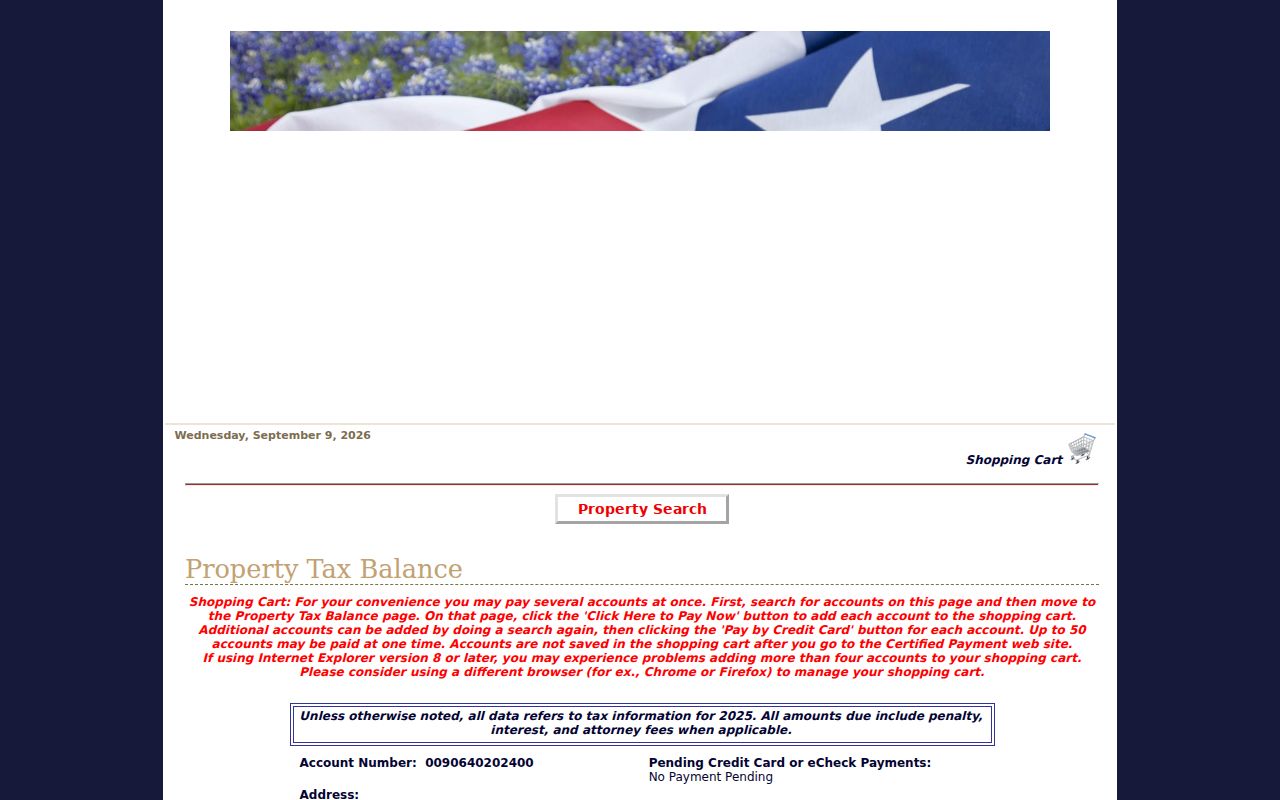
Sample records in the tax system can be nonlocal. No visible name, address, or value in them proves anything about a Montgomery County parcel, so search a confirmed account and compare its legal description.
Where Montgomery County Ownership Appears
No single screen answers every ownership question. The assessment roll gives the quickest present-name clue, GIS ties it to geography, and the newest recorded conveyance supplies the stronger documentary confirmation.
| Source | Owner Info It Gives | Access |
|---|---|---|
| Appraiser roll | Displayed owner and parcel details | Official parcel route; live fields unverified |
| Register of Deeds | Grantee, legal description, instrument | Counter, phone, mail, fax, or email |
| Kansas Business Search | Entity filing identity | Official statewide portal |
| ORKA viewer | Parcel geography and linked detail | Free viewer after certification |
Owner of record, taxpayer, and occupant can differ. A grantee may be a trust, estate, or LLC. A tax mailing address can even lead to an agent, an office, or another property entirely.
Trace the Latest Montgomery County Deed
Hand the Register of Deeds the legal description and party-name variants. The office records deeds, mortgages, releases, maps, plats, leases, liens, and powers of attorney. It publishes no stable online deed index. Direct contact with the office is therefore authoritative. Visit 217 E Myrtle Street, second floor, Independence, weekdays 8 a.m. to 5 p.m. You can also call 620-330-1140, fax 620-330-1144, email mpcalhoun@mgcountyks.org, or mail PO Box 647. Ask for the newest deed matching the land. Then compare the grantee, recording date, legal description, and prior reference. Do deeper chain work on the deed-records page.
Decode LLC, Trust, and Estate Owners
An LLC or corporation on the deed points elsewhere. Search the exact legal name with the Secretary of State. A business filing can confirm the entity exists. An agent address, though, is not a residence and reveals none of the beneficial interests. Read trustee wording straight from the instrument. An estate, executor, transfer-on-death reference, or probate matter may lead to the 14th Judicial District. Court records explain authority, but the recorded conveyance remains the property-specific link.
Watch Future Filings With a Free County Notice
The county's free Recording Notification Service alerts a registrant when a document is recorded under a chosen name or property. It is a solid fraud-awareness tool. An alert never blocks a recording. It does not validate the instrument or establish ownership. Review any referenced filing with the Register of Deeds and seek help if it looks unauthorized.
Ownership Research Continues Offline
Web outages do not stop ownership research. The courthouse counter, phone, mail, fax, and email still work. For older context, Kansas Historical Society microfilm circulates through research and library-loan channels, and the 1881 Montgomery County atlas provides historical landowner maps and town plats. Neither names today's owner. Use old names to build deed-search variants, then return to the latest conveyance in current county records.
Handle the Recent-Sale Gap Without Guessing
A deed date and a roll update differ. No exact lag or refresh interval is published. When a sale looks recent, write down the roll name and the date you accessed it. Then ask the Register of Deeds for the newest conveyance matching the legal description. Compare the grantee and the recording date. Claim no standard delay. If the two sources disagree, the latest matching recorded deed is the stronger current clue. The Appraiser can explain the roll's update status. A contract, listing, tax payment, utility account, or visible occupancy is never a substitute for the conveyance record.
Request an Existing Owner Record Precisely
Online lookups do not always answer the question. In that case, ask the Appraiser for the existing property record card, the assessment classification, the displayed owner and mailing fields, the legal description, and the assessment year. The Register of Deeds is a separate stop. Request the latest deed there, plus any deed that document references. Public-record offices fulfill record requests. They will not build a title history or rule on legal ownership of the land.
The county KORA form lets you choose a printout, photocopy, or electronic format. It also accepts a narrow date and parcel range. The County Clerk provides a cost estimate. For recorded instruments, contact the recorder directly, since a general county administrative request does not substitute for the deed office's own copy process.
Match Names Without Merging Different Owners
Owner names rarely look identical across Montgomery County records. Expect initials, former surnames, trustee language, estate titles, punctuation quirks, and abbreviations. Write down each spelling exactly as it appears. Treat the variants only as leads. Before concluding that two hits involve the same parcel, demand a second match through the legal description, the parcel number, or a prior deed reference.
Entities need extra care. Separate the legal name from any trade name and registered agent. For co-owners, copy the full vesting line, and keep any trustee or representative wording because it explains why the name differs from the tax line.
Rank Montgomery County Owner Evidence by Purpose
| Evidence | What it supports | What it does not settle |
|---|---|---|
| GIS result | Geographic match | Boundary or title |
| Assessment roll | Displayed appraisal owner | Recent-sale timing |
| Tax account | Taxpayer and account context | Occupancy or beneficial interest |
| Latest deed | Recorded conveyance and grantee | Every lien, easement, probate issue, or unrecorded claim |
The strongest answer usually comes from agreement among the sources. When the deed, tax roll, and appraisal data conflict, treat it as a prompt to confirm the legal description, the dates, and the instrument references with the office responsible for each record.
What a Montgomery County Owner Lookup Cannot Prove
A public name in Montgomery County property records proves ownership on paper, nothing more. It cannot establish who lives at the property. It cannot show where a person is now, who benefits behind a trust, or whether title is complete. Kansas Safe at Home lets qualifying participants substitute an address in public records. Redactions and similar protections narrow the picture further.
Use owner-of-record information for legitimate purposes. Purchase diligence, estate work, boundary questions, and fraud prevention all qualify. Keep personal details to a minimum. Never use a property search to stalk, harass, or harm anyone.
Not proof of title. An assessment name is a starting point. Recent transfers, entities, estates, easements, liens, and other interests require recorded-document review and sometimes professional title work.
Date Every Montgomery County Ownership Finding
Log every ownership finding as you go. Save the access date, the tax or parcel identifier, the displayed name, and the legal description. Note the source type as well. Later, if another source differs, that log tells you why. The change might reflect a new deed. It could also be a tax roll update, a corrected description, or a mistaken parcel match. Never present a dynamic sample as the subject property.
For purchase or estate research, rerun the official checks close to the decision date. Database screens change, and a snapshot does not guarantee what the office will later certify. When you pull a deed result, note whether it is an index entry or an image. Note whether it is an ordinary copy or a certified copy. Record the execution and recording dates separately.
State every final owner finding plainly, with its source and date. If the latest deed and the assessment roll disagree, describe the discrepancy. Contact the offices rather than silently blending the records. Keep copies or instrument references alongside the parcel's legal description. A future Montgomery County owner lookup can then retrace the path. It can tell an actual transfer from a routine database correction.