
Inside Montgomery County Property Tax Records
A tax account bundles three kinds of information without merging them. The Montgomery County Appraiser classifies property and sets its value. The Treasurer publishes the bill and collects the resulting tax. Same account, different jobs. Before comparing any figures, check the tax year and the as-of date the county attaches to them. Values and balances move on separate clocks.
| Field | What It Shows | Where |
|---|---|---|
| Gross, land and improvement values | Components displayed with the account valuation | Appraiser and ACT account detail |
| Capped or agricultural value | Special valuation fields when applicable | ACT account detail |
| Exemptions | Exemption entries attached to the account | Appraiser and ACT detail |
| Current and prior amounts due | Base balance and collection status | Treasurer tax system |
| Penalty, interest and ACC | Additional collection costs and date-sensitive charges | Tax-by-year detail |
Expect the account to list the site address, the owner mailing address, the legal description, the levy, the last payment, pending electronic payments, and any active lawsuits. Those fields make it easier to reconcile a bill. Still, a tax balance proves nothing about title. Neither does a mailing label. For ownership questions, trace the legal description to the recorded deed, which is the document that actually controls title.
How Montgomery County Turns Value Into Tax
The Appraisal Process values real property as of January 1 each year. Market or agricultural-use value is multiplied by the Kansas assessment ratio, then the resulting assessed value is multiplied by the combined mill levy and divided by 1,000. Exemptions, credits, penalties, interest, and collection adjustments can change the final amount.
- Appraised value
- The Appraiser's market-value estimate, except agricultural land is valued by use through an income approach.
- Assessed value
- The taxable value after applying the statutory classification ratio.
- Mill levy
- The combined rate imposed by the applicable taxing jurisdictions per $1,000 of assessed value.
- Tax lien
- A claim associated with unpaid taxes; it is not the same as the ordinary current bill.
Under K.S.A. 79-1439, residential real property and mobile homes are assessed at an 11.5% ratio. Commercial and industrial real property carries 25%. Vacant lots and nonprofit-use property sit at 12%, public utility property at 33%, and agricultural or other listed property at 30%. Treat these as assessment ratios only. They are not tax rates, and confusing the two skews every figure that follows.
Note: Compare the same property classification and tax year; otherwise a ratio, levy, or value comparison can mislead.
Four Official Keys Open the Tax Account
The Treasurer's property-tax page publishes four ways in: owner name, address, statement number, or tax ID. Each key fits a different starting point.
| Search key | Best use | Check next |
|---|---|---|
| Owner name | Known taxpayer or entity | Match site address and legal description |
| Address | Known physical location | Keep the account or tax ID |
| Statement number | Existing paper or electronic bill | Confirm tax year |
| Tax ID | Exact account already identified | Review status and as-of date |
The county-linked parcel portal publishes no confirmation of its search fields or refresh schedule. So the Treasurer's four keys remain the dependable tax route. Resist guessing at an owner-field label the portal has never announced.
Read the ACT Account From Top to Bottom
Start with the identifiers, not the dollar total. Match the account number, site address, legal description, and tax year first. Then work through the money. Note the current levy and the current amount due. Add the prior-year amount due, the total due, and the last payment posted. The valuation block adds gross, land, improvement, capped, and agricultural values along with exemptions. The official ACT account-detail layout shows where each field and link sits on the screen. The sample it displays is not a Montgomery County parcel. Use it as a map, not as evidence.
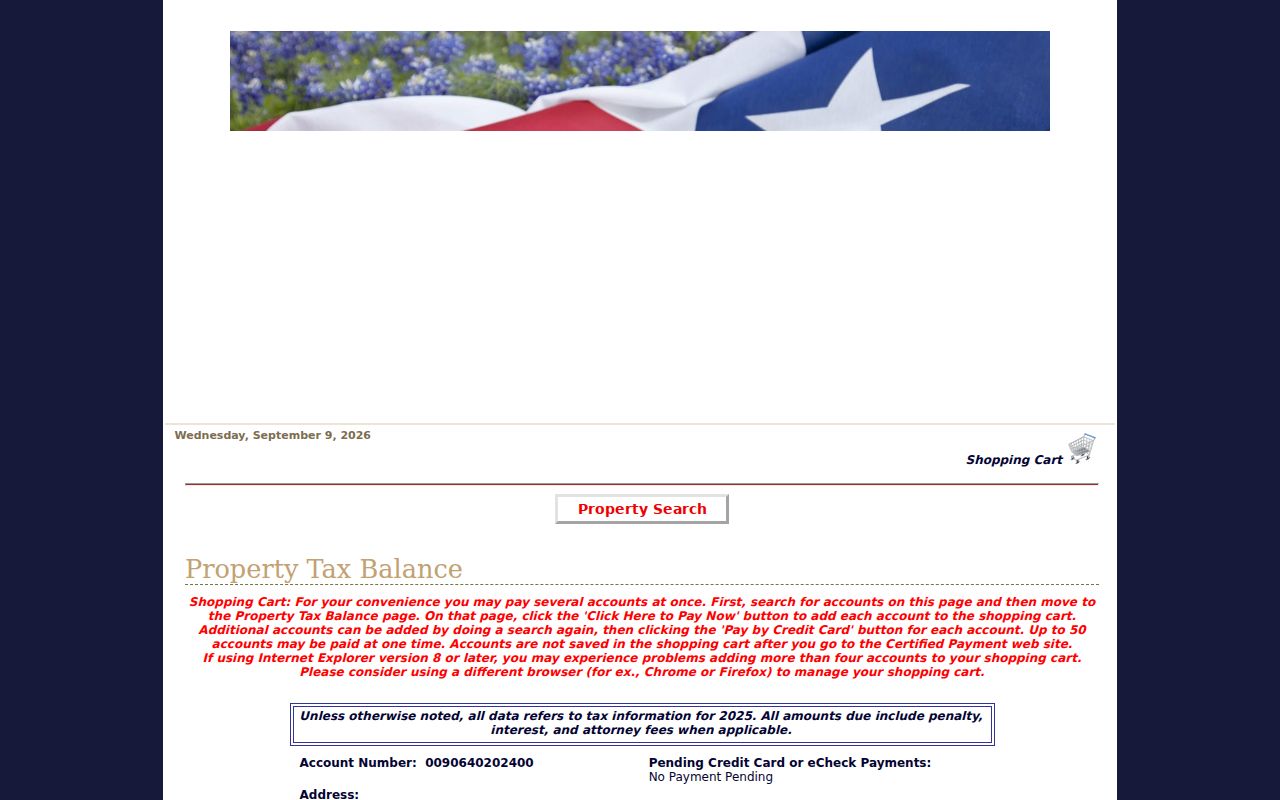
Treat the layout as a field guide, then pull up a confirmed Montgomery account before trusting any number. Payment, receipt, statement, tax-rate, exemption, yearly-tax-detail, and estimated-date links all branch from this screen. Knowing where they sit saves time.
Look Up a Montgomery County Tax Bill
Keep a small audit trail while checking Montgomery County property tax records. A saved account number, tax year, and access date explain later why a displayed balance changed. Memories fade; notes do not.
- Open the Treasurer's official tax route and search by owner, address, statement number, or tax ID.
- Match the site address and legal description, then record the account number and year.
- Read the current levy, current and prior amounts due, last payment, exemptions, and yearly detail.
- For delinquency, call the Treasurer at 620-330-1100 for a current payoff rather than relying on the web total.
The Treasurer offers in-person help at 217 E Myrtle Street, first floor, Independence. Hours run Monday through Friday from 8 a.m. to 4 p.m. The mailing route is PO Box 767. For written requests, existing non-exempt records can be sought narrowly. Use the county KORA form to submit them. The form supports printouts, photocopies, or electronic delivery and supplies a cost estimate up front.
Penalty, Interest, and ACC Change With the Date
The tax-by-year report sorts the account by tax as-of date, year, base tax due, penalty, interest, Additional Collection Costs, and total due. It also names levy jurisdictions and flags active lawsuits.
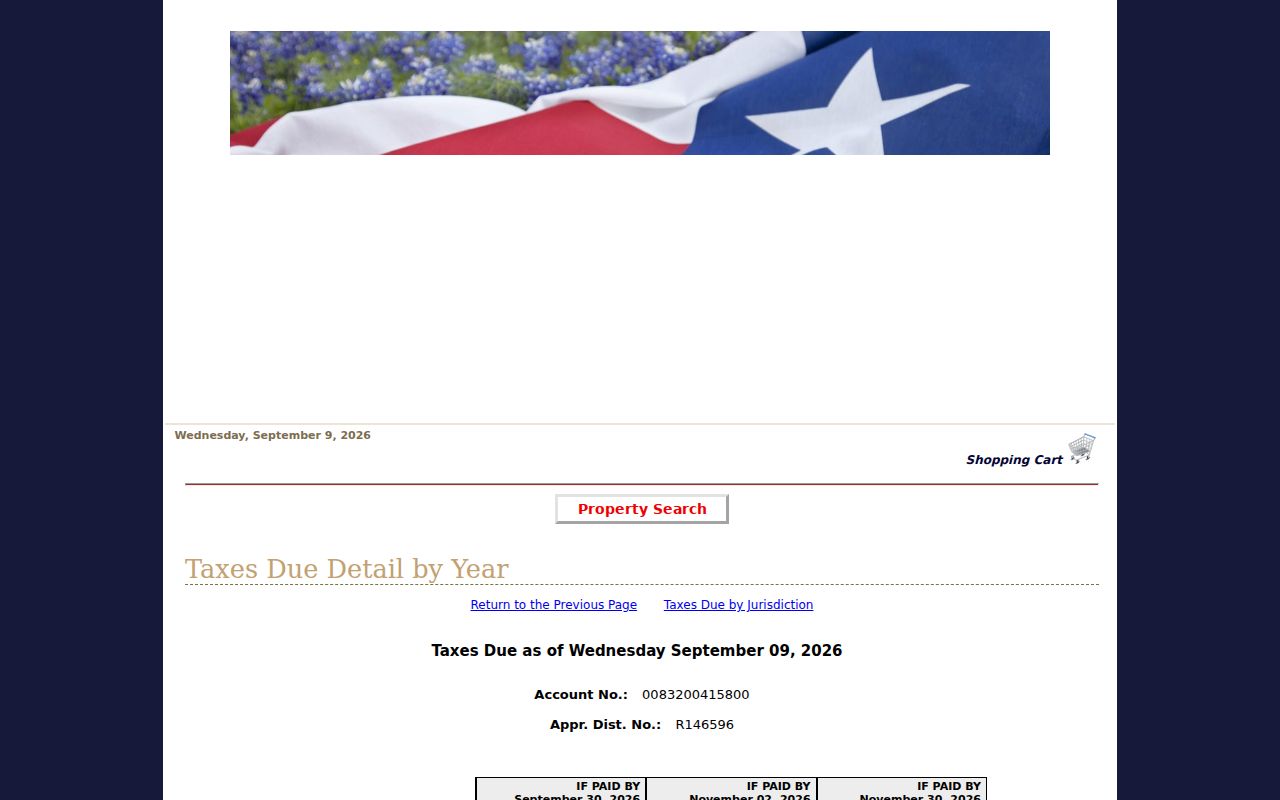
The report's separate columns show why a dated payoff figure matters: the base amount and later collection additions are not one number. Montgomery County itself cautions that website figures are not accurate for delinquent interest and penalties. Confirm directly with the Treasurer. That call is the safer move before any payment or closing.
Delinquent payoff. Call 620-330-1100 for the amount due on the intended payment date; an online snapshot can age immediately.
Portfolio and Electronic Statement Options
The tax portfolio adds login and account-organization tools for anyone tracking more than one statement. The separate electronic-statement route takes more setup. Per the portal, it requires an owner affirmation, email verification within three days, and registration by September 15.

The portfolio is a convenience layer, not a different tax roll. Keep the parcel identifiers close, and confirm every imported account is the property you meant. The electronic statement registration walks through the owner-affirmation and verification workflow step by step.
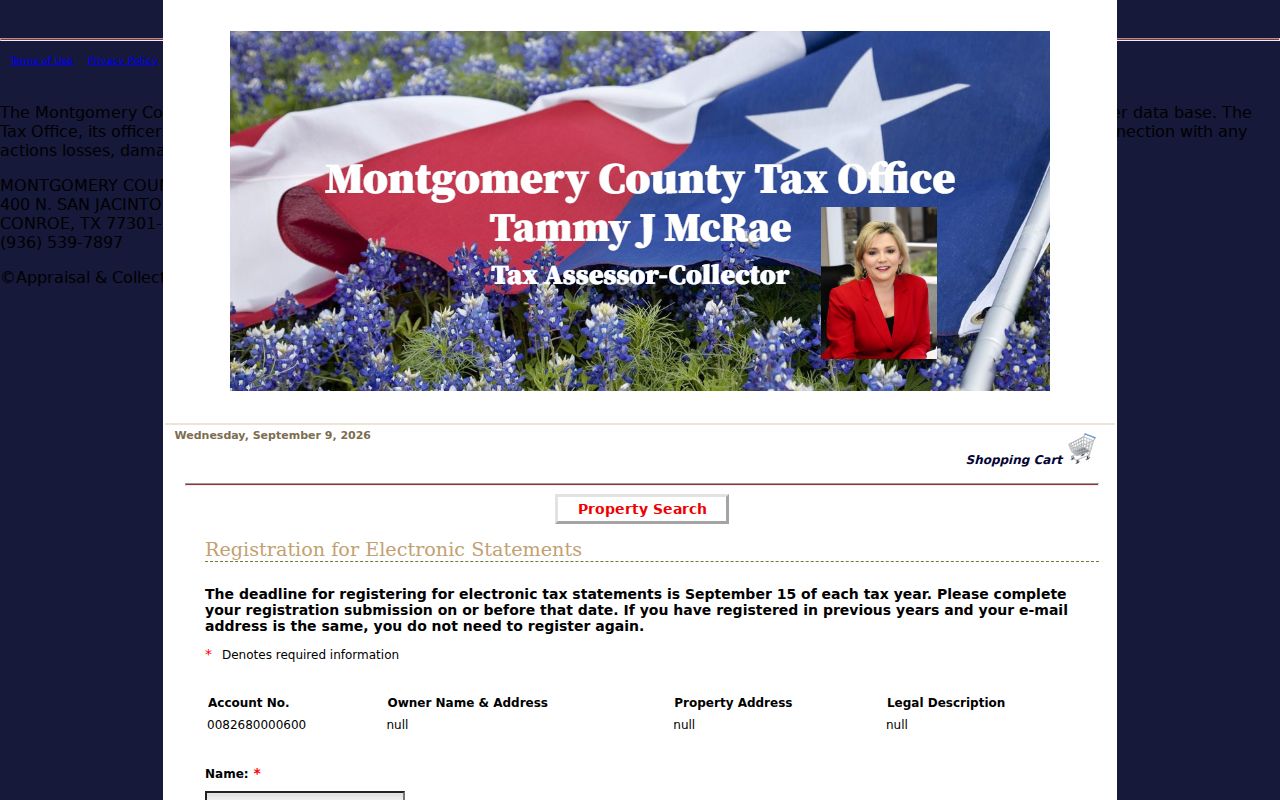
Registration is account-specific, so start from a confirmed Montgomery tax ID and finish the email verification promptly. A receipt request is a different animal. The county form there asks for contact information, the tax year, an electronic signature, and a choice about an email copy.
The 2026 Montgomery County Market Study
The Appraiser reported an overall inflationary trend of roughly 3% in the 2026 market study. The trend covers residential, commercial, and vacant land. That figure describes the county as a whole. It promises nothing for one parcel. Improvements, condition, square footage, corrected descriptions, and neighborhood sales can all push a single account to a different result. Market conditions and equalization can too. For an appeal, aim the evidence at the subject property itself. The county's appeal guidance names the types that count. These include an independent appraisal, recent comparable sales, current listings, photographs, repair estimates, or a written estimate from a real-estate professional.
Contest a Montgomery County Assessment
Start with the property description and the valuation record itself. Ask what you are actually disputing. A factual error in square footage, condition, classification, or improvements is one thing. Arguing the market supports a lower value is another. Gather photographs, estimates, comparable sales, and the notice, sorted by tax year. Then work through the live steps on the Appeals Information page.
Appeal window. The research did not verify the current Montgomery County protest deadline or form. Check the current notice and county appeal page before filing.
Request Missing Montgomery County Tax Records
Going online is only one route. The Treasurer takes questions in person. Payoff requests go by telephone. Mail reaches the office at PO Box 767, and other requests go through county procedures. Want a statement, receipt, payment history, or delinquency record? Provide the tax ID or statement number. Include the property address, the legal description, and the years involved. State your preferred format too. Get a cost estimate first if you plan to order many copies.
The county receipt form is narrower than it looks. It asks for requester contact details. It also asks for the tax year, an electronic signature, and a choice about an email copy. It requests a receipt, not an ownership search. For other existing non-exempt administrative records, the county KORA form is the fallback. It offers printout, photocopy, or electronic delivery. That form does not require anyone to create a new calculation, appraisal, or title history.
Keep Montgomery County Tax Figures Separate
| Number | Meaning | Common mistake |
|---|---|---|
| Market or use value | Appraiser's valuation basis | Treating it as the bill |
| Assessed value | Value after statutory ratio | Treating ratio as tax rate |
| Sale price | Transaction consideration | Assuming one sale sets appraisal |
| Amount due | Date-sensitive collection balance | Using it as property value |
Agricultural land shows why this separation matters. Montgomery County appraises it at use value through an income approach, not at what it might fetch on the open market. So corrections to improvements, area, condition, classification, or neighborhood evidence can shift an appraisal even when they match neither a sale price nor a current balance.
A Dated Tax-Sale Notice Is Not an Annual Calendar
The county's 2026 tax-sale notice announced an October 6 auction at Memorial Hall in Independence. Preregistration was set for September 14 at the Treasurer's office. It required identification and an affidavit. Bidders were checked for delinquent county taxes. The notice also specified accepted payment forms and listed a $21 recording fee per parcel.
Those details apply to that notice alone. A later sale can change the date, location, prerequisites, inventory, and payment rules. And a sale list is not a deed, nor a promise that every interest has vanished. So confirm the live notice first. Inspect the tax account. Locate the parcel through the Appraiser or GIS. Research recorded instruments before bidding.
Note: Publication in the Independence Reporter on specified 2026 dates documents notice, not a permanent publication schedule.