
Trace Montgomery County Former Owners Through Time
A dependable chain starts with the newest confirmed deed and works backward. Montgomery County publishes no verified earliest year for a stable online deed index, so assume no web cutoff. The Register of Deeds, historical county microfilm, recorded plats, and dated ownership maps each fill a different stretch of the trail.
| Source | Years It Covers | Where Held | What It Shows |
|---|---|---|---|
| Recorded deeds and index | Current coverage; earliest online year unverified | Montgomery County Register of Deeds | Grantor, grantee, instrument reference, dates, and legal description |
| County deed microfilm | Historical holdings vary by reel | Kansas Historical Society; library loan may be available | Earlier deed and county-record entries |
| 1881 county atlas | 1881 snapshot | Kansas Memory | Township landowners, town plats, and period context |
| 1916 Independence plat book | 1916 snapshot | Kansas Historical Society | Lots, blocks, additions, and mapped parcel context |
Start at the courthouse for the legal chain. Use the atlas or plat book to interpret an old legal description, not to name a present owner. A historical map is a dated snapshot. A recorded conveyance is what actually moves title from one party to another.
Ask the Montgomery County Register of Deeds for the Chain
The Montgomery County Register of Deeds records deeds, mortgages, releases, maps, town plats, liens, and oil and gas leases. It also records powers of attorney and other instruments. The office sits on the courthouse second floor at 217 E Myrtle Street, Suite 205, Independence. Hours run Monday through Friday, 8 a.m. to 5 p.m.
Researchers can visit, call 620-330-1140, fax 620-330-1144, email mpcalhoun@mgcountyks.org, or mail PO Box 647, Independence, KS 67301. Bring the property address and any known owner. Include the legal description, approximate dates, and any book, page, or document number. Ask which index, terminal, staff help, and copy options cover the period needed.
Montgomery County Former Owners Are Not All Online
The official sources publish no stable Montgomery County online deed-index address. They also state no verified first online year. The county was organized in 1869. That fact alone does not prove any web index reaches back to organization. A failed portal or missing web result never signals a break in ownership.
Coverage limit. The online cutoff is unverified; use the Register of Deeds and Kansas Historical Society microfilm for older links.
The best fallback chain runs through direct office contact and an in-person index or deed-book search. The KSHS county-record microfilm route covers older material. Ask a Kansas library about interlibrary loan before buying a reel.
Reconstruct Montgomery County Previous Owners Backward
Read the chain in reverse from one known, recent instrument. Names alone can collide. Match each step by legal description, and carry forward spelling variants, entity names, dates, and prior-record references.
- Identify the latest confirmed deed and note the grantee, recording date, instrument or book/page, and full legal description.
- Read the grantor on that deed. That party is the next former owner to investigate.
- Find the earlier deed where that grantor appeared as grantee, then verify that the legal description matches.
- Repeat while logging mortgages, releases, easements, restrictions, plats, and probate clues without mistaking them for conveyances.
- When searchable digital coverage ends, continue through deed books or microfilm rather than ending the chain.
- Grantor / grantee
- The conveying party and receiving party named in an instrument.
- Chain of title
- The ordered sequence of recorded transfers affecting the same real estate.
- Reverse index
- An index used from a grantee name to locate the deed by which that party acquired title.
- Warranty / quitclaim deed
- Different conveyance forms; the document and title context determine their effect.
- Legal description
- The lot, block, addition, or land description that persists when an address changes.
Log Each Montgomery County Ownership Transfer
A working timeline keeps one similar name or unrelated parcel out of the history. Record what each source actually says, retain its identifier, and separate execution dates from recording dates.
| Transfer date | Grantor to grantee | Deed type | Book/page or instrument |
|---|---|---|---|
| Latest recorded date | Current link in the chain | As labeled on the instrument | Exact recorder reference |
| Prior recorded date | Earlier owner to next owner | As labeled on the instrument | Exact recorder reference |
| Earlier book era | Names transcribed from index and deed | Deed or other conveyance | Book and page |
Note all exhibits and prior-deed citations. A mortgage release clears a financing instrument but names no new owner by itself. A plat gives land-division context yet proves nothing about every encumbrance affecting title.
Probate Can Explain a Montgomery County Ownership Break
An estate, guardianship, or heir interest can interrupt a tidy seller-to-buyer chain. The Kansas Historical Society identifies Montgomery Probate Court journals from 1870 through 1917. They sit on microfilm AR2321 through AR2326. Those journals explain administration and guardianship proceedings. They still do not replace a recorded deed.
Search the decedent, executor or administrator, heirs, and later deed parties. Do this through the 14th Judicial District. The court clerk, not the county KORA form, handles court records. Compare any court clue to the later conveyance. That conveyance put the property into a new name.
The 1881 Atlas Adds Color to Montgomery County Former Owners
The 1881 Historical Atlas of Montgomery County holds township landowner maps, town plats, business references, and county history. It shines when a chain reaches descriptions built on township, range, section, quarter, lot, block, or an early townsite.
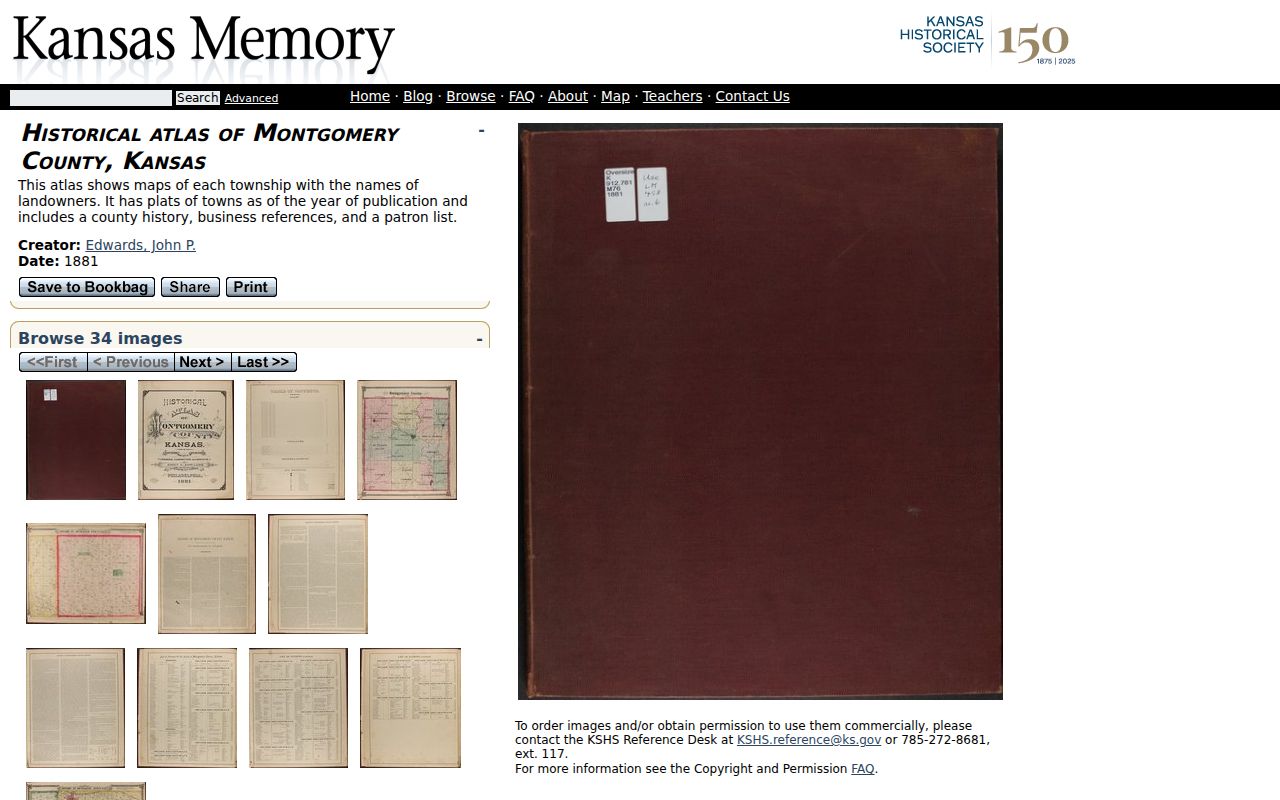
Names on an atlas page are historical evidence, not current title. Verify the mapped tract against later instruments before adding anyone to a finished chain.
Local Directories Help Test Past Montgomery County Owners
Coffeyville Public Library lists local newspapers, city directories, census records, and genealogy holdings. It also offers a microform reader. Its Coffeyville directories begin in 1900. Its Independence directory holdings cover 1961 through 1983 and 2002 to the present. Newspaper runs and other series have their own gaps.
A directory can tie an occupant or business to an address in a single year. A newspaper may supply a sale, fire, construction, or estate date. Neither proves ownership. Use that date and name. Then locate the deed, plat, probate file, or other official record that does.
Independence Public Library also provides local-history and genealogy help. Cherryvale's library identifies a local history room and date-specific newspaper research. Give staff an exact person, place, and date whenever possible. Record the publication title, issue date, page, and repository. That way each clue traces back to its source.
Gauge How Far Montgomery County Prior Owners Go
No single starting year applies to every Montgomery County chain. The records simply begin where they begin. A search may run from current deeds back through recorder books and county microfilm. It can then reach the 1881 atlas, town plats, probate journals, and federal land or Public Land Survey System material. Each stop answers a narrower question and carries its own date.
For old or ambiguous land, normalize township, range, section, and quarter descriptions using KSHS land-record guidance. Town plats connect lot and block labels to later streets. From there, return to recorded instruments for every transfer. Keep that discipline up. It can trace former owners past modern addresses without assuming an online span no source supports.
Lawful use. Research past owners for property history, estate work, or purchase diligence, never to track, intimidate, or harass a living person.
KSHS lends Montgomery County microfilm through a Kansas library's interlibrary-loan process. Out-of-state researchers can ask a Family History Center about access. The KSHS Archives Catalog also lists government records, maps, manuscripts, photographs, and newspapers. Many holdings are not digitized, though. These offline routes matter because the Register of Deeds publishes no online deed-index cutoff.
When an estate interrupts the chain, contact the 14th Judicial District clerk with a party name, approximate docket date, case number if known, and document type. Montgomery County's general KORA form excludes District Court records. Review the court file first. Then go back to the Register of Deeds for the conveyance or affidavit tying the proceeding to the legal description.
This ladder of sources separates former owners from people who merely occupied, managed, mortgaged, or paid taxes on the parcel. A prior owner belongs in the chronology only when a conveyance and legal description support the link. Other dated property records stay labeled as context.