
What Montgomery County Deed Records Contain
The Montgomery County Register of Deeds records far more than deeds. The office also files mortgages, affidavits, maps, oil and gas leases, liens, corporation papers, powers of attorney, and military discharges. Instrument type matters here. Not every recorded item transfers ownership. A deed conveys an interest in land, while a mortgage, lien, release, or plat documents a different piece of the property record. Knowing which category you are reading keeps a deed search on track.
| Recorded instrument | Its role | Useful question |
|---|---|---|
| Warranty deed | Conveys the stated real-property interest with deed covenants | What transfer was recorded? |
| Quitclaim deed | Conveys whatever interest the signer has without promising its extent | Was an interest released or shifted? |
| Executor or fiduciary deed | Records a transfer made under estate or fiduciary authority | How did an estate convey land? |
| Mortgage or release | Records or releases a secured claim | What financing instrument affects the tract? |
| Plat or replat | Depicts lots, blocks, dedications, and easements shown on the filed plan | Which recorded subdivision description applies? |
A document's heading is only a first clue. Read the granting language, the parties, the legal description, the signatures, the acknowledgments, and the recorder reference in the full image or copy before deciding what an instrument actually does.
The Montgomery County Register of Deeds Route
The official Register of Deeds page is the dependable access point. The county publishes no stable online deed index of its own. Visitors will find the office in Suite 205. It sits on the second floor of the courthouse at 217 E Myrtle Street, Independence, Kansas 67301. Hours run Monday through Friday, 8 a.m. to 5 p.m. Anyone searching Montgomery County property records by deed should plan on working with the staff directly.
Visit or deliver
217 E Myrtle St, Suite 205
Independence, KS 67301
620-330-1140
Mail or contact
PO Box 647, Independence, KS 67301
Fax: 620-330-1144
mpcalhoun@mgcountyks.org
Ask the office what identifying information, advance payment, and return method a particular deed record requires. The page lists phone, fax, email, physical, and mailing channels. No web index simply means the property search happens through the office rather than a portal.
Following Montgomery County Grantors and Grantees
A chain search works person by person. Each grantor and grantee pair points you toward the transfer before it. That builds the chain link by link. The county offers no online form for this, and it publishes no earliest searchable year, so the Register of Deeds staff will assist the workflow.
- Identify the present deed by current grantee name and the tract's exact legal description.
- Read that instrument for its grantor, recording reference, date, and prior deed reference.
- Search the grantor as an earlier grantee and match the same land description.
- Repeat the link, checking mortgages, releases, easements, plats, probate matters, and name changes.
- Move to deed books or microfilm when the available index no longer covers the needed period.
- Grantor
- The party conveying the stated interest.
- Grantee
- The party receiving that stated interest.
- Chain of title
- The linked sequence of instruments affecting the same tract.
- Book/page or instrument number
- The recorder's reference used to retrieve a filing.
Why Montgomery County Legal Descriptions Control the Match
A street address helps you find property. Deeds, though, identify land by legal description. In platted areas of Montgomery County, that may mean an addition, block, and lot. Rural land often uses Public Land Survey System terms or another recorded description. Address spelling and postal geography can change without the legal tract changing at all. Match deeds by address alone and you risk joining the wrong parcel to your chain. Copy the legal description from a confirmed tax account. A current deed or a filed plat works too. Compare it across every link. Watch for partial-interest language, exceptions, and references to easements or earlier filings. When descriptions conflict, do not force the records into one sequence. Ask the Register of Deeds for help. They can identify the right book, page, instrument number, plat, or replat. Seek professional help when the difference affects title.
Montgomery County Recording Fees by Instrument
The county's recording fee schedule separates instruments rather than setting one universal charge. Instruments of writing run $21 for the first page and $17 for each additional page. A mortgage assignment or release costs $20 for the first page. Added pages run $4 each. Town plats are listed at $32 per page.
| Certificate | $13 |
|---|---|
| Acknowledgment | $12.50 |
| Materials or services lien | $17 |
| Lis pendens | $5 |
| Federal tax lien notice or release | $32 |
These are recording categories, not a quote for every plain or certified copy. Confirm the current fee and payment method with the office before sending money. Page count or certification can change the request entirely.
A Free Montgomery County Recording Alert
Montgomery County offers a Recording Notification Service at no charge. A subscriber selects a name. When an official record is recorded under that name or on that property, an email notice goes out. An unexpected alert is a reason to contact the Register of Deeds promptly. It is also wise to inspect the instrument itself.
The service supports property-fraud awareness, but its scope has limits. An alert proves nothing about ownership. It does not replace routine review of deed records. And it cannot guarantee that every relevant filing has been matched. It simply tells the subscriber something. A recording tied to the chosen name or property may deserve a closer look.
Older Montgomery County Deeds and Maps
Older land records survive, even without an online index. The Kansas Historical Society holds Montgomery County records on microfilm. It lends them through library interlibrary loan. Its land-record guidance also points researchers toward deed materials. The same guidance covers Public Land Survey System sources, General Land Office resources, and property ownership maps or plat books.
The 1881 Historical Atlas of Montgomery County adds township landowner maps, town plats, business references, and county history. Treat it as a historical lead. It is not proof of present title, but it can anchor the next deed-book question.
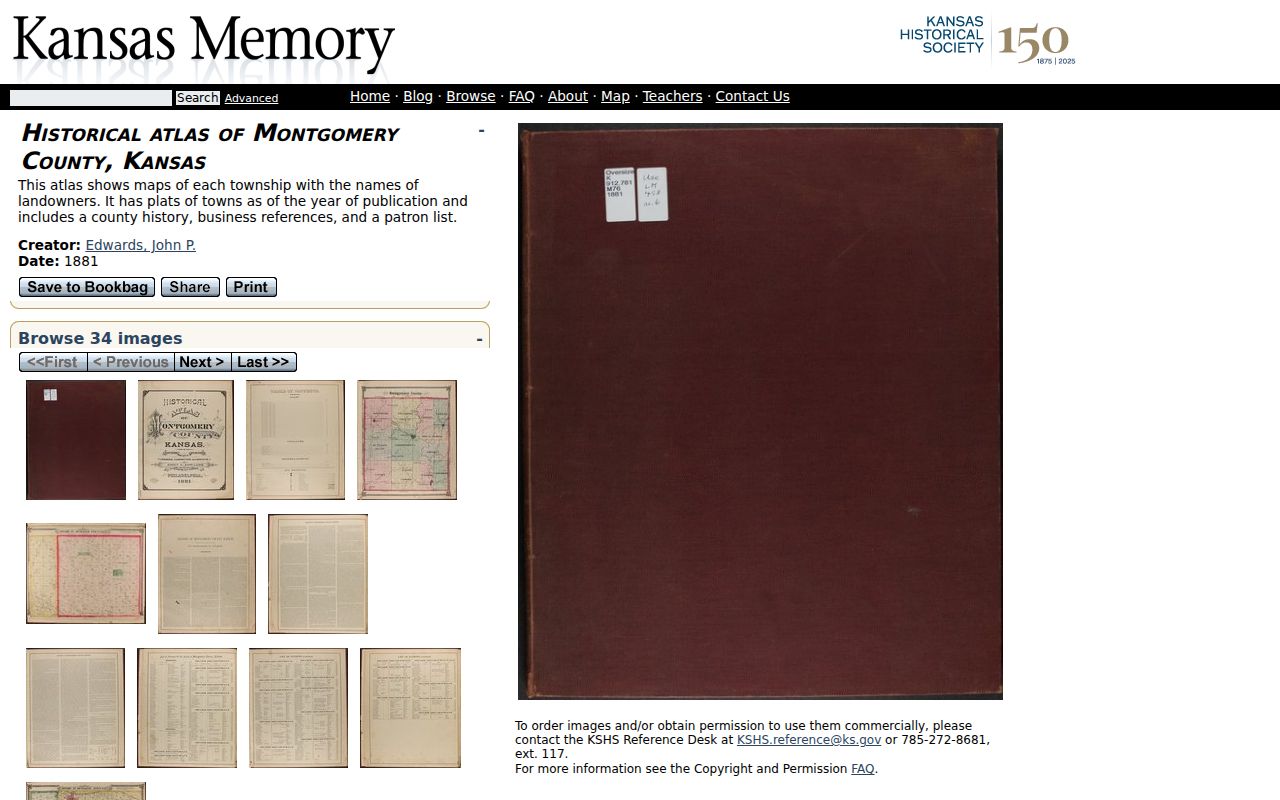
Use an atlas name or lot reference to frame the next deed-book or microfilm question, then verify the chain through recorded instruments. Libraries can bridge date gaps with newspapers and directories. Remember, though, that occupant history and ownership history are not always the same thing.
Plats, Easements, and Montgomery County Deed Research
A filed plat rewards a careful reader. It can show lots, blocks, easements, dedications, certificates, and references that sharpen any deed search in Montgomery County. Coffeyville's Westmoreland Park Addition replat is a good example. That official document lists lot areas, certificates, an easement, a dedication, and a deed-book and page reference. It connects a city subdivision name to county deed records.
Plats have limits, though. No plat settles every boundary question. A plat will not reveal every encumbrance either. Read the instrument references, compare later replats or lot splits, and retrieve the deeds and easement documents affecting the exact lot. County parcel-split and land-use forms are administrative records, not substitutes for the recorded title file, and when a map and deed conflict, a licensed survey and title review may be needed.
Ordering a Montgomery County Deed Copy
Prepare the request before calling the office. Give the grantor and grantee names, the document type, an approximate recording date, the full legal description, and any known book, page, or instrument reference. Say whether a plain or certified copy is needed. Ask the office to confirm the charge and acceptable payment, and mail requests to the official PO Box 647 address unless staff instructs otherwise.
Missing pieces change the plan. Begin with the Montgomery County property search process to obtain an account key and legal description. For historical material, ask whether the office record, a deed book, or KSHS microfilm is the correct source. Keep the office response and its production date. Index entries and portal displays can change later.
Recorded does not mean guaranteed. Montgomery County deed records show instruments accepted for recording. They do not identify every unrecorded interest, certify clear title, replace a survey, or provide a legal title opinion.
Keep the copy with a short source log. Record the office, the exact URL or contact channel, and the request and production dates. Add the document reference. Note whether the item is an index entry, image, plain copy, or certified copy. That detail matters later. A future search may return a changed screen or a clearer scan. The log settles which version you hold. Older images can carry protected identifiers. Never republish them.
Court events belong to the 14th Judicial District, not the county KORA form. Probate, foreclosure, quiet-title, partition, and judgment files may explain why a deed was signed. The court index is not itself the conveyance, though. Follow the case to the resulting recorded instrument and compare the same legal description. Federal matters run through the District of Kansas and PACER. Use them only when the dispute or lien is federal.
Long time spans need a different tactic. Start with the newest confirmed deed and move backward one link at a time. That cuts false matches among similar names. It also exposes gaps. Ask for a cost estimate before a large production. An unavailable online index never proves the courthouse books or microfilm are gone. Note every spelling variant and recorder reference exactly as it appears. Changing a name or legal description can break the next search link.